

Julian Drago
Stanford GSB · Business Scaling Program
Program University of Buenos Aires · Public Accounting
Date published:
March 15, 2025
Last updated:
August 27, 2026
Reviewed by
Sebastián Mejía

An ITIN (Individual Taxpayer Identification Number) is a nine-digit tax identification number that the Internal Revenue Service (IRS) assigns to certain individuals who need to comply with federal tax obligations in the United States but are not eligible to obtain a Social Security Number (SSN). Its primary purpose is to allow the IRS to process tax returns and other tax-related matters for individuals who are not eligible for an SSN.
Having an ITIN does not mean that a person is authorized to work in the United States, that they are eligible to receive Social Security benefits, or that their immigration status has changed. Its purpose is strictly tax-related, and it may be used by certain resident aliens and nonresident aliens, as well as certain spouses and dependents who meet the requirements established by the IRS.
The need to apply for an individual tax identification number depends on each person's tax circumstances. In general, there must be a federal tax purpose that justifies the application. In many cases, this involves filing a federal tax return together with Form W-7, although specific exceptions allow individuals to apply without filing a tax return.
An ITIN allows the IRS to identify an individual for tax purposes when they need a federal taxpayer identification number and cannot use an SSN.
It may be required when a foreign individual has an obligation to file a U.S. tax return, needs to claim certain permitted tax benefits, or must provide a taxpayer identification number for a situation covered by IRS rules.
Some of its primary uses include:
An ITIN does not replace an SSN in every situation. They are different identifiers, and each serves a specific purpose.
For example, a person who is eligible to obtain an SSN generally must apply for that number instead of an tax identification number for individuals. The IRS reserves the ITIN system for individuals who need a federal taxpayer identification number but are not eligible for a Social Security Number.
There is no single circumstance that automatically determines whether someone must have an individual tax identification number. The need arises when certain tax circumstances apply and the individual cannot obtain an SSN.
Some of the most common situations include:
A nonresident alien may need an ITIN when they are required to file a federal tax return or meet a tax obligation and are not eligible for an SSN. This may occur when they receive certain types of income subject to federal taxation in the United States and need to file the corresponding tax return.
The term "resident" for tax purposes does not necessarily mean a lawful permanent resident from an immigration perspective. The IRS determines tax residency using specific rules.
A person may be considered a resident for federal tax purposes even if they do not have a permanent resident card. Therefore, tax and immigration analyses must be kept separate when determining whether an ITIN should be requested.
In certain joint tax returns or tax situations, a foreign spouse may need an ITIN to be properly identified by the IRS.
Certain dependents who cannot obtain an SSN may need an individual tax identification number to be included on a tax return and, when applicable, allow the taxpayer to claim a permitted tax benefit.
The rules for dependents may be more specific because certain tax benefits require proof of U.S. residency or compliance with additional requirements.
There are also situations in which an individual may apply for this tax identification number because they need to meet a specific federal obligation covered by the instructions for Form W-7.
For this reason, it is not advisable to apply for an ITIN simply because it may be useful in the future. The IRS requires a valid reason related to federal tax administration.
One of the most common misconceptions is that all identification numbers serve the same purpose.
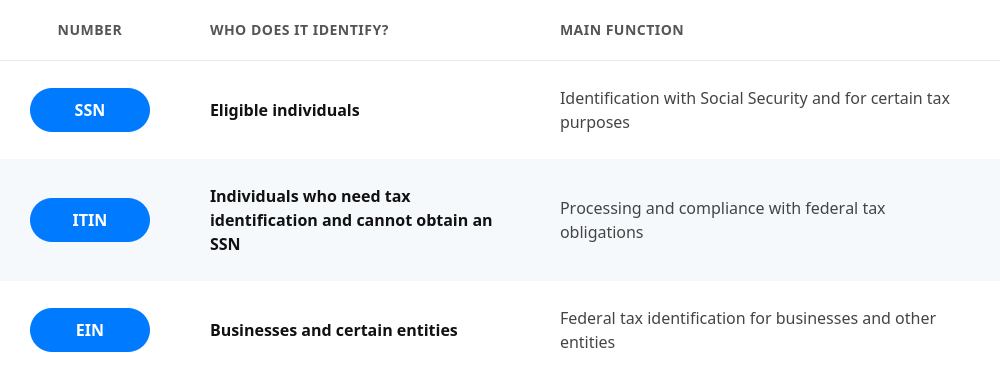
For example, a foreign individual who owns an LLC may need an EIN for the business and, depending on their personal tax circumstances, an ITIN for themselves. Obtaining one of these numbers does not automatically eliminate the need for the other.
This distinction is particularly important for foreign LLC owners because the business structure and individual tax obligations are analyzed separately. The ITIN is used for individual tax identification, while the EIN identifies certain entities and businesses.
This identification number is not an immigration or employment authorization document, but an individual tax identification number can be essential for properly meeting certain tax obligations.
Its primary benefit is providing taxpayers with a way to identify themselves to the IRS when they cannot use an SSN.
Under certain circumstances, having an ITIN may allow an individual to:
Some private institutions may also accept an ITIN as part of their identification procedures. For example, certain banks, lenders, or credit card issuers may accept this tax identification number instead of an SSN, although this depends on each institution's policies.
Financial sources such as NerdWallet indicate that certain financial products may be available to individuals who use an individual tax identification number, but requirements vary by provider.
Obtaining an ITIN does not provide rights associated with other documents or programs.
In particular, this number:
Its purpose is tax-related. The IRS states that an individual taxpayer identification number is used for tax processing purposes and not to determine employment or immigration eligibility.
The application generally begins with Form W-7, Application for IRS Individual Taxpayer Identification Number.
Depending on the reason for applying for this tax identification number, you may also need to submit a federal tax return and documentation proving your identity and foreign status.
The IRS requires each applicant to submit appropriate documentation to establish these elements before an individual tax identification number can be issued.
Form W-7 is the official application used to obtain or renew an individual taxpayer identification number. You must correctly select the reason for your application and provide information such as:
An error in this information may cause the IRS to request additional documentation or reject the individual tax identification number application.
In most cases, an initial application must be submitted together with a federal tax return. The IRS provides specific exceptions.
If you qualify for one of these exceptions, you must provide documentation showing that you meet the applicable requirements to request the taxpayer identification number without attaching a tax return.
You must also provide acceptable documents that establish your identity and foreign status.
A passport is one of the most important documents among those accepted by the IRS, although other documents may be used depending on the circumstances.
The documents must meet the validity requirements established by the IRS. The instructions for Form W-7 contain the specific table of acceptable documents.

Before completing Form W-7, identify the tax-related reason that justifies your application. Simply not having an SSN is not enough. The IRS requires a federal tax purpose or that the applicant falls within a recognized exception.
If you are eligible for an SSN, an individual tax identification number is not the substitute you should use simply for convenience. The application must correspond to an individual who needs identification for tax purposes and cannot obtain an SSN.
Carefully review every field before signing. It is especially important that the name matches the documents used to establish your identity and that the reason for the application corresponds to your circumstances.
If the application requires a federal tax return, prepare the applicable form and attach it to Form W-7. If you qualify for an exception, gather the documents showing why you do not need to submit a tax return with the application.
Make sure that your documents are acceptable and valid. Do not submit documents at random. The IRS has specific requirements regarding which documents it can accept and when additional documentation is required.
There are several ways to submit an application for this tax identification number. You can mail it to the IRS or request in-person assistance through certain offices or authorized agents.
Acceptance Agents and Certifying Acceptance Agents approved by the IRS can assist with preparing the application. Certifying Acceptance Agents have additional authority to authenticate certain supporting documents and return them to the applicant rather than requiring the applicant to send them directly to the IRS.
Once the application is received and reviewed, the IRS processes the documentation and, if everything is in order, assigns the Individual Taxpayer Identification Number.
Processing times may vary depending on application volume, the time of year, and whether the IRS requires additional information. Therefore, any published processing time should be considered an estimate rather than a guarantee.
One option is to mail Form W-7 along with the required documentation and, when applicable, the federal tax return to the IRS. This method may be convenient for individuals who do not have access to an authorized agent or who prefer to handle the process directly.
There are also IRS Taxpayer Assistance Centers that can process certain ITIN-related matters. Generally, you should verify whether the service is available and schedule an appointment before visiting.
Another option is to work with an agent authorized by the IRS. This can be particularly useful for applicants who want assistance completing Form W-7 or prefer to avoid sending certain original documents directly to the IRS.
The IRS maintains a list of approved agents both inside and outside the United States, including agents available in different countries.
Yes. Living outside the United States does not automatically prevent you from obtaining an ITIN.
An individual residing in another country may need an Individual Taxpayer Identification Number because of certain federal tax obligations or situations covered by IRS rules.
The process will depend on the reason for the application and the documentation available. You may also be able to use certain authorized Acceptance Agents located outside the United States. The IRS maintains lists of international agents, including some in Latin American countries and other regions.
This can be particularly useful for individuals who have income, investments, property, or other tax connections with the United States but permanently reside in another country.
The IRS does not charge a government fee to issue an ITIN.
However, you may incur expenses related to tax return preparation, document translation or certification, or services provided by an Acceptance Agent or Certifying Acceptance Agent.
The IRS itself indicates that agent fees may vary.
Therefore, it is important to distinguish between the official cost of an ITIN, which does not involve an IRS issuance fee, and professional fees that may apply if you receive assistance.
Not all taxpayer identification numbers remain active indefinitely.
An ITIN may expire under the applicable rules, and if you need to use it again to file a tax return or claim certain tax benefits, you may need to renew it.
The IRS indicates that a person with an expired ITIN may experience delays in processing their tax return and may not receive certain tax benefits until the required renewal is completed.
The process uses Form W-7 again, but you must select the option corresponding to the renewal of an existing number.
If your name has changed since the number was issued, you must include documentation supporting the change, such as a marriage certificate or court order, when applicable.
Spouses and dependents renewing their ITIN to be claimed for an eligible tax benefit must also meet specific requirements related to the applicable federal tax return.
Not having an SSN is not, by itself, enough. The IRS requires a valid reason for submitting Form W-7.
Your name, date of birth, and other information must be consistent with the documentation you submit.
Not all identification documents are acceptable in every situation. In addition, certain dependents may need to meet additional residency requirements.
A person may be considered a resident for tax purposes even if their immigration situation is different. These are separate legal concepts and should be analyzed independently.
If you can obtain an SSN, you must follow the appropriate procedure. The ITIN is designed for individuals who are not eligible for an SSN and have a recognized federal tax need.
If you know you will need to use it again, check its status and the applicable renewal rules before filing future tax returns.

A foreign individual who owns an LLC in the United States may have tax obligations requiring both an EIN for the entity and an individual taxpayer identification number for the owner.
However, not every person who owns an LLC automatically needs an ITIN.
The need will depend on factors such as:
For this reason, owning an LLC and needing an ITIN are related but not equivalent matters.
A foreign owner should not apply for an ITIN simply because they own an LLC. They should first determine whether there is a federal tax obligation or purpose that justifies the application.
Once you receive the number, carefully review the IRS notice and keep the document with your tax records.
It is also advisable to:
The number should be treated as part of your tax records, so it is important to protect it and avoid sharing it unnecessarily.
An individual taxpayer identification number is a tool created to allow certain individuals who cannot obtain an SSN to properly meet their federal tax obligations in the United States. Its purpose is tax-related and, by itself, it does not provide work authorization, immigration residency, or Social Security benefits.
Before submitting Form W-7, the most important steps are to determine whether there is actually a tax-related reason that justifies the application, identify the documentation you need, and determine whether you must file a federal tax return or qualify for an exception.
The process can be completed directly with the IRS or through an authorized Acceptance Agent. If the application is complete and the documentation meets the requirements, it will be easier to avoid delays caused by incorrect information or insufficient documentation.
For individuals living outside the United States or those with business structures, investments, income, or tax connections to the country, determining whether an ITIN is appropriate may require a more specific analysis. In these cases, it is advisable to review the current IRS instructions and seek professional guidance. At Openbiz, you can find professional assistance to manage your tax obligations with greater security and confidence.
No. An SSN and an ITIN are different identifiers. The latter is primarily intended for individuals who need a number for federal tax purposes and are not eligible for an SSN.
No. Having this number does not constitute employment authorization. Its function is exclusively tax-related.
Yes. Some individuals who live outside the United States may need an ITIN for federal tax purposes. In addition, there are IRS-approved Acceptance Agents in various countries.
Generally, yes, but there are exceptions. If you qualify for an exception, you must submit documentation demonstrating that you meet its requirements.
Under certain circumstances, yes. The spouse must meet the applicable requirements and submit their own Form W-7 when necessary.
Yes, when the dependent meets the requirements established by the IRS. Some situations require additional documentation to prove U.S. residency.
Processing times may vary. The IRS must review the form and supporting documentation submitted, so errors or incomplete applications may cause delays.
Yes. You can submit the application directly using the methods established by the IRS. You can also use an authorized Acceptance Agent or Certifying Acceptance Agent.
If you need to use it for a tax return or tax benefit, you should check whether it needs to be renewed. Filing a return with an expired number may cause delays and affect certain tax benefits.
Some financial institutions accept this identifier as part of their identification requirements, but there is no general obligation for all banks to do so. Each institution establishes its own criteria.
Some lenders and credit card issuers accept ITINs for certain applications. However, acceptance, credit requirements, and terms depend on each institution.
If you later become eligible for an SSN, you must follow the applicable instructions from the IRS and the Social Security Administration. The tax identification number is not intended to permanently replace an SSN once an individual becomes eligible for one.



Concierte una reunión virtual gratuita con nuestro equipo de expertos.
Programar una reunión
Compare precios y elija el plan ideal para su empresa.
Ver planos y precios