Julian Drago
Stanford GSB · Business Scaling Program
Program University of Buenos Aires · Public Accounting
Date published:
July 1, 2026
Last updated:
August 27, 2026
Reviewed by
Sebastián MejíaThe EIN of an LLC is a nine-digit federal tax identification number assigned by the Internal Revenue Service (IRS). It is used to identify certain tax accounts of the business and may be required to hire employees, file certain tax returns, make tax deposits, or complete banking and state-related procedures, as explained in the IRS’s official EIN guidance.
However, having an LLC does not mean that every business must use an EIN in the same way. The answer depends on the number of members, the entity’s tax classification, whether it has employees, and the taxes it is required to report. Even a single-member LLC may have its own employer identification number and still be required to use its owner’s SSN or applicable identification number on certain federal forms.
.jpg)
EIN known in Spanish as the Employer Identification Number or federal tax identification number. Although its name refers to employers, it is not limited to businesses with employees: the IRS also assigns EINs to partnerships, corporations, trusts, estates, and other entities that need a federal tax account.
The employer identification number follows the format XX-XXXXXXX. It does not replace an individual's SSN or ITIN and should not be used as personal identification. Its purpose is to identify the business or a specific tax account with the IRS.
In practice, an LLC may use it to:
The EIN is important, but it is worth avoiding a common misconception: obtaining it does not create the LLC, determine its tax classification, or guarantee limited liability protection. The LLC is created under the laws of the state in which it is formed. Liability protection depends, among other factors, on applicable law, compliance with corporate formalities, and maintaining a genuine separation between personal and business operations.
The following table provides general guidance. The specific situation may vary depending on the tax classification selected and applicable state requirements.
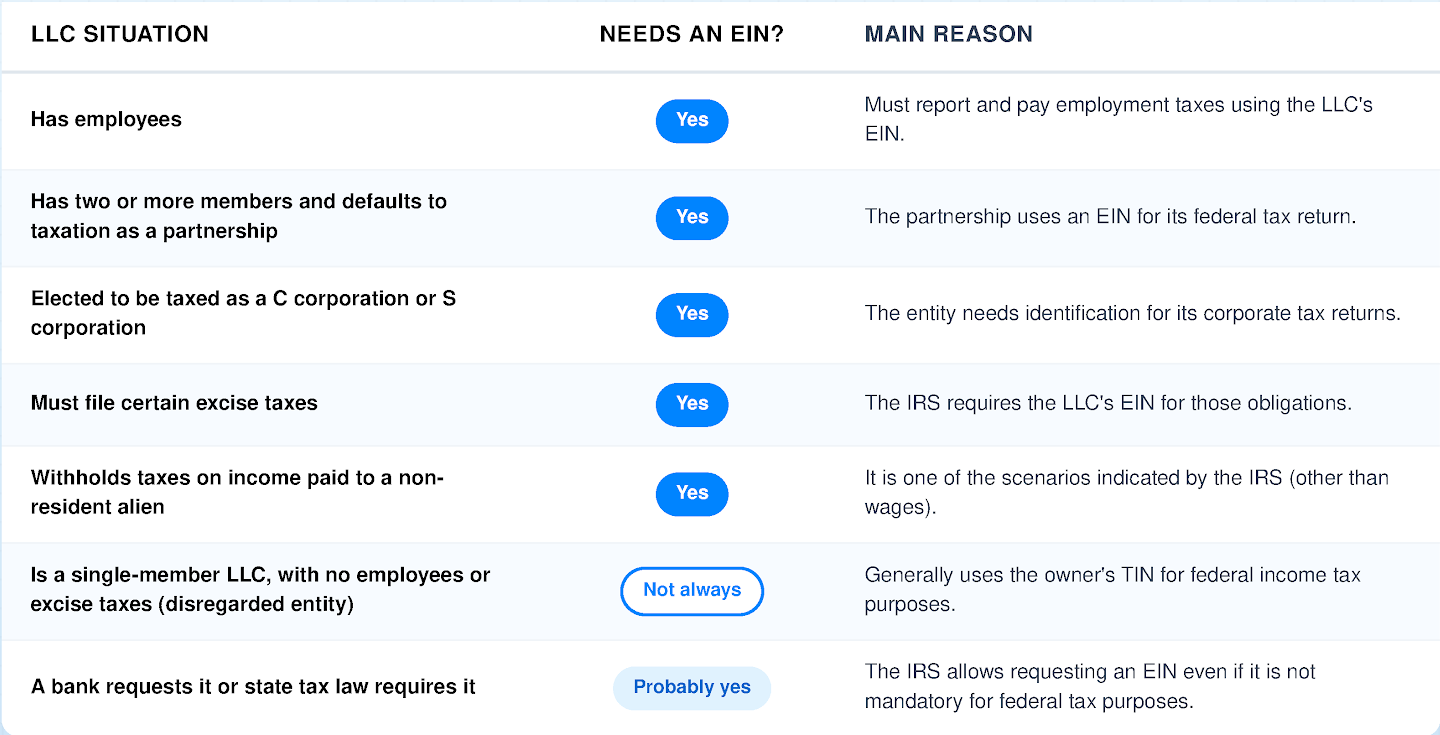
A domestic LLC with two or more members is classified by default as a partnership for federal income tax purposes, unless it elects to be treated as a corporation by filing the appropriate form. In either case, it will generally need an EIN to file its tax returns and maintain the entity’s federal tax account.
A domestic single-member LLC is treated by default as a disregarded entity for federal income tax purposes unless it elects to be taxed as a corporation. This generally means that its income and expenses are reported on the owner’s tax return.
If the LLC has no employees and no excise tax obligations, the IRS states that it does not need its own EIN for federal tax purposes. It may nevertheless obtain one if required to open a bank account or if a state law requires it. This distinction appears in the IRS explanation of single-member LLCs.
There is an important distinction: for income tax-related information returns, a single-member LLC treated as a disregarded entity generally must use the name and TIN of its owner. For example, under certain circumstances, Form W-9 must show the owner’s SSN or EIN, rather than the entity’s own employer identification number. However, for employment taxes and certain excise taxes, the entity must use its own name and employer identification number.
When an LLC hires employees, it needs an EIN to report wages, withholdings, and employment tax obligations. This also applies to a single-member LLC treated as a disregarded entity: for employment tax purposes, it is treated as a separate entity and uses its own EIN.
These identifiers serve different purposes:
An EIN does not grant residency, work authorization, immigration status, or permission to operate a regulated business. It also does not automatically make its holder a U.S. individual taxpayer. Personal and business tax obligations must be analyzed separately.
The IRS recommends forming the legal entity first. Therefore, if you are creating an LLC, wait until the state approves its formation before applying for the employer identification number. Applying too early can create discrepancies between the entity’s legal name on state records and the information provided to the IRS.
Prepare the following information:
The responsible party generally must be an individual, not a company or a simple nominee. If the responsible party does not have an SSN or ITIN and is not eligible to obtain one, the official Form SS-4 instructions allow the applicant to enter “foreign” or “N/A” on line 7b. This does not mean that all foreign applicants follow the same procedure; the available application method also depends on where the applicant’s legal residence, principal office, or principal place of business is located.
Verify that the state has approved the Articles of Organization, Certificate of Formation, or equivalent document. Check the legal name, formation date, and number of members. If there is an error in the state registration, correct it before transferring the information to the federal application.
The number of members is not merely an administrative detail. A domestic single-member LLC is generally treated as a disregarded entity, while an LLC with two or more members is generally taxed as a partnership, unless it makes a valid election to be treated as a corporation.
Form SS-4 requests information about the type of entity, but it does not replace Form 8832 for electing corporate tax classification or Form 2553 for requesting S corporation status. Before selecting an option, confirm how the LLC will file its taxes.
The responsible party is the individual who controls, manages, or directs the entity and the disposition of its funds. This should not be confused with an incorporator, registered agent, or service provider who merely carries out instructions.
Third parties may assist with preparing the application and, when properly authorized, act as designees on the application. However, the IRS warns that a nominee without actual authority is not authorized to apply for the employer identification number as though they were the responsible party.
The procedure varies depending on the applicant’s location.

You can use the IRS online application if you meet the system requirements and the applicant has a valid TIN. Applying directly through the IRS is free, and when the information is successfully validated, the employer identification number is assigned at the end of the session.
You can also submit Form SS-4 by fax or mail. According to the IRS, a domestic application submitted by fax with a return fax number may receive a response in approximately four business days. By mail, the estimated processing time is about four weeks, although this may vary if there is a backlog of applications.
International applicants cannot use the online application if they do not have a legal residence, principal place of business, office, or agency in the United States or its territories. According to the IRS's current procedure for international applicants, they may:
Phone numbers, fax numbers, hours, and mailing addresses may change. Before submitting any information, check the details on the official IRS website and avoid websites that imitate its identity.
Errors involving the name, address, classification, or responsible party can delay processing. Use the legal name consistently, correctly indicate the number of members, and do not submit simultaneous applications through different channels.
The IRS limits issuance to one employer identification number per responsible party per day, regardless of whether the application is submitted online, by phone, fax, or mail. In addition, each entity should have only one EIN; submitting multiple applications can create duplicate records that later need to be clarified.
Store the assignment notice securely together with the company’s organizational documents. If you apply online, download the confirmation at the end of the session. The EIN can be used immediately for many activities, such as opening a bank account, applying for licenses, or filing a paper tax return.
However, the IRS warns that it may take up to two weeks for the number to become available in certain systems, such as electronic tax return filing, electronic tax deposits, or the TIN matching program.
A foreign owner who does not have an SSN or ITIN may apply for an EIN if the entity and the application meet the applicable requirements. Under the current Form SS-4 instructions, line 7b allows the applicant to enter “foreign” or “N/A” when the responsible party does not have an SSN or ITIN and is not eligible to obtain one.
This does not make the applicant eligible to use the online application. To access the electronic system, the principal responsible party must have a valid TIN, and the applicant must meet the presence requirements established by the IRS. Anyone who does not meet those requirements must use the international application procedure by phone, fax, or mail.
It is also incorrect to state that every foreign individual must first obtain an ITIN to get an employer identification number.. They are different identifiers, and Form SS-4 specifically addresses situations involving a foreign responsible party without an SSN or ITIN. However, that individual may still need an ITIN for other individual tax obligations; this must be evaluated separately.
Receiving the number does not complete all of the LLC's obligations. Consider following this checklist:
This can cause the federal record to differ from the state record. The correct sequence is to form the entity first and then apply for the employer identification number.
Receiving the number does not automatically make an LLC an S corporation or C corporation. Tax elections require separate forms and eligibility requirements.
A registered agent or service provider does not become the responsible party simply by assisting with the application. The application must identify the individual who exercises actual control over the entity.
Using multiple channels at the same time does not speed up the process. It can result in multiple federal tax identification numbers and complicate tax returns, bank accounts, and communications with the IRS.
For a single-member business treated as a disregarded entity, the W-9 rules may require the owner's name and TIN for federal income tax purposes. You should follow the current form instructions and not assume that the business tax identifier is required in every situation.
The federal tax registration identifies a tax account; it does not prove that the entity is in good standing, has the necessary licenses, has filed all required returns, or complies with beneficial ownership, state, or local requirements.
A change in name, address, or responsible party generally does not require a new employer identification number. In these cases, the information is updated with the IRS through the applicable procedure.
By contrast, a change in ownership or structure may require a new number. The answer depends on how the LLC was classified and on the transaction involved. For example, adding a new member can change the federal tax treatment of a single-member LLC; a reorganization, merger, or change in legal form may also have consequences.
Do not apply for a new employer identification number simply as a precaution. Review the IRS guidance on when a new number is required and consult a tax professional if there has been a substantial change.

An EIN for an LLC is much more than a requirement for simply “having a business.” Its use varies depending on the number of members, tax classification, whether the company has employees, and the tax returns it is required to file. Therefore, the best starting point is not to immediately complete Form SS-4, but to confirm that the LLC has already been formed, properly determine its tax treatment, and identify the responsible party.
If your LLC is located in the United States and you meet the IRS online application requirements, applying online may be the fastest option. If you are a foreign owner without a legal residence, principal place of business, or office in the country, use the international application procedure and carefully review Form SS-4. In both cases, applying directly through the IRS is free.
If you prefer assistance organizing the information, reviewing the form, and following up on the process, you can learn more about Openbiz's incorporation service or schedule a consultation. Professional assistance does not replace personalized legal or tax advice when your structure, tax residence, or business activity involves special circumstances.
Applying directly through the IRS is free. A private company may charge for preparing, reviewing, or managing the application, but it does not sell the number or charge a government fee for issuing it. The scope and price of any assistance service should be explained separately.
An online application may result in an assignment at the end of the session if the system successfully validates the information. The IRS estimates approximately four business days for fax responses and about four weeks for applications submitted by mail. These are estimates, not guarantees; backlogs or errors may extend the processing time.
Yes. The IRS provides procedures for international applicants by phone, fax, and mail. Not having an SSN or ITIN does not automatically prevent you from applying, but you must provide accurate information about the responsible party and use the appropriate application channel.
It depends on the financial institution, type of entity, and its policies. The IRS allows an LLC to apply for an EIN for banking purposes, even if it does not need an employer identification number for federal tax purposes. However, the bank may request additional documents and may reject an application even if the business has an employer tax identification number.
Not by itself. Limited liability arises from the legal structure and applicable state law. Maintaining separate accounts, documenting transactions, complying with obligations, and avoiding commingling of funds may be relevant, but the analysis depends on the specific circumstances.
An EIN does not have a periodic expiration date. It remains associated with the entity's tax record. If the business stops using it, the IRS does not cancel it as though it had never existed, although the account may be deactivated according to IRS procedures.
First, check the original notice, previous tax returns, banking documents, or licensing records. If you cannot find the number, an authorized person can contact the IRS Business and Specialty Tax Line. To confirm the EIN, the IRS also allows eligible taxpayers to request an entity transcript, download a digital CP 575 notice through a Business Tax Account when available, or request a 147C Letter.
Yes, for many business purposes. However, for electronic tax return filing, electronic payments, or TIN verification, you may need to wait up to two weeks for the number to appear in the relevant systems.
Openbiz may provide administrative assistance with preparing and managing the application when included in the contracted service. The responsible party must provide accurate information and review the application. Third-party assistance is optional: you can also apply for the employer identification number directly and free of charge through the IRS.



Concierte una reunión virtual gratuita con nuestro equipo de expertos.
Programar una reunión
Compare precios y elija el plan ideal para su empresa.
Ver planos y precios